Gingham Dog Quilt Part III

Note two sizes of yo-yo’s.

YO-YO’S:  This was really fun.    Suzanne Sawko has always been charmed by yo-yo’s and made a vest of Liberty yo-yo’s for an article in Creative Needle magazine.  But she did it the fast and easy way.  She created a machine embroidery design that does the most tedious part of yo-yo construction, turning under the raw edge, most of it bias.  I’ve always kept that technique in mind…..

After completing the floss weaving through the entredeux and pinstitch on this quilt, it needed something.  There was a bit of congestion at the entredeux intersections and it just lacked……dimension.  That was my objection to the design.  It lacked dimension.  So I decided to make yo-yo’s with Suzanne’s machine embroidery file.  The technique is so simple, so obvious, so neat. And it could be done without an embroidery machine.
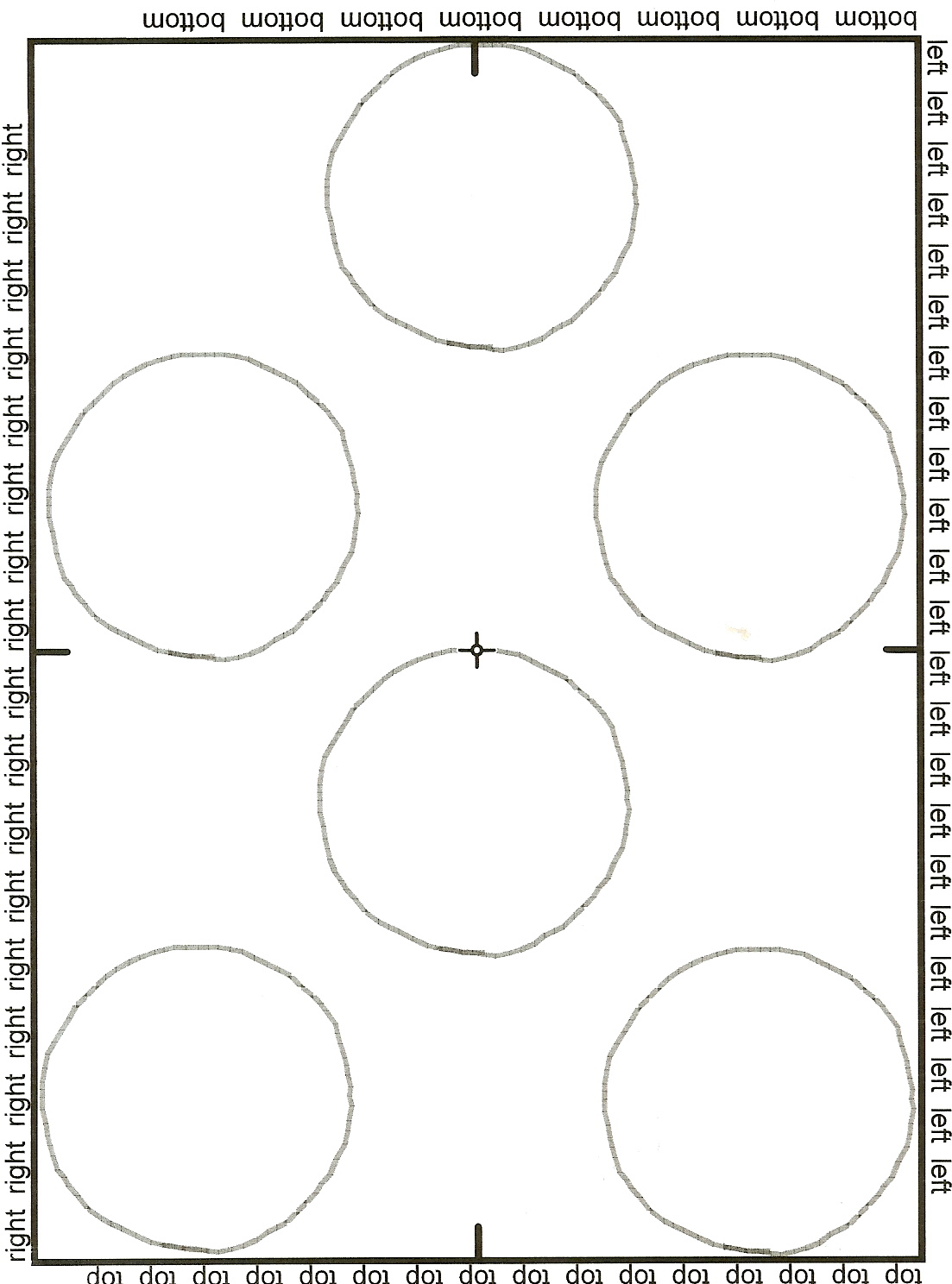
Liberty and regular, original weight Solvy (or other water soluble stabilizer) was hooped together, with the Liberty right side facing up, covered with Solvy.  Then 6 circles were straight stitched, at least 1/2″ apart, the smaller size in the 5 x 7 hoop (130mm x 180mm) and the larger size in the  160mm x 260mm hoop.   After the stitching was complete, the Liberty and Solvy were removed from the hoop and cut out, 1/4″ away from the stitching line.  A slit was made in the Solvy and the circle turned, like a pillow top.  Using a point turner, the outline was smoothed and  then the circle was pressed. The result is a perfectly turned circle.  Continue reading

Gingham Dog Quilt Part II

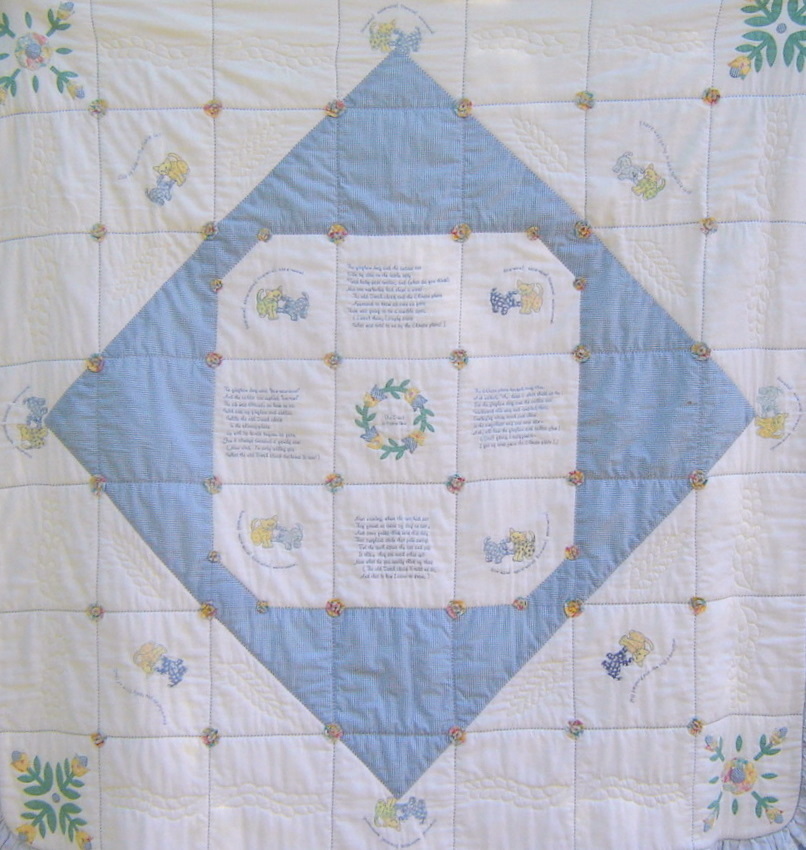
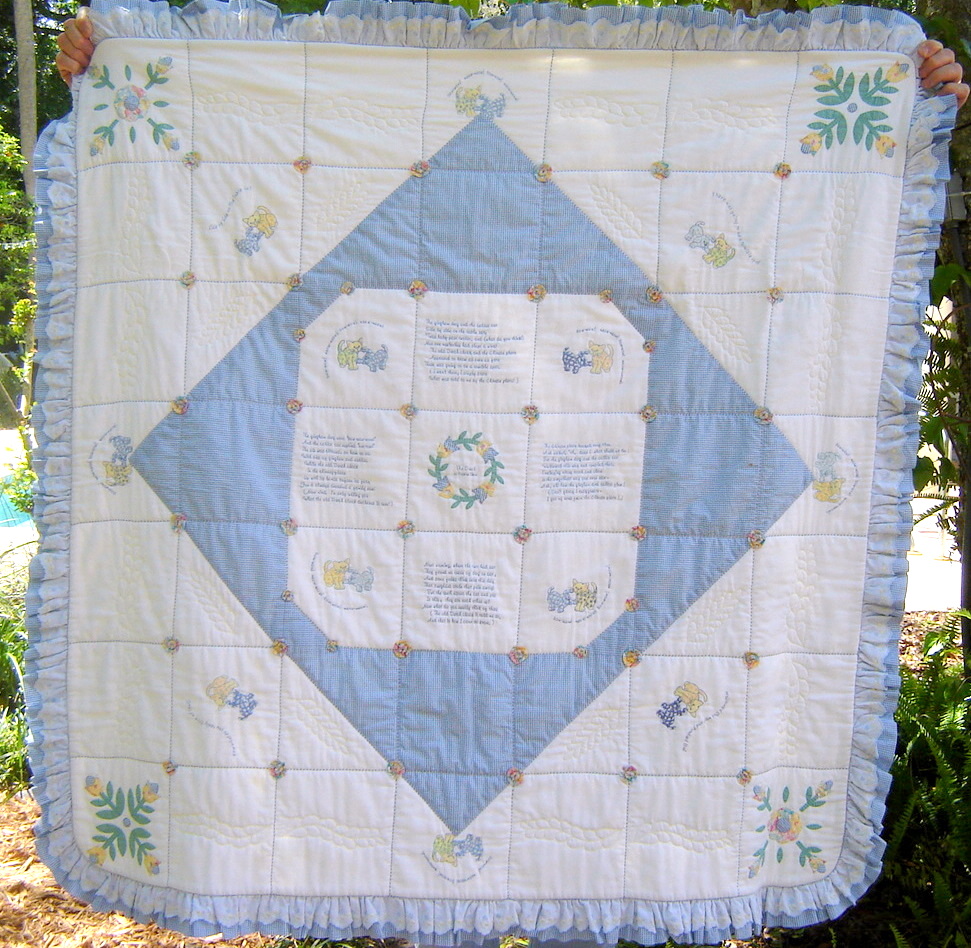
At this point, there is a large square of Swiss flannel in the center, framed with four blue gingham triangles, creating a medallion. Four smaller triangles create the “snowball.”  The perimeter of the flannel snowball  is pinstitched, with the holes from the wing needle in the flannel and the “reach” stitch in the gingham.  The perimeter of the square gingham frame is also pinstitched.

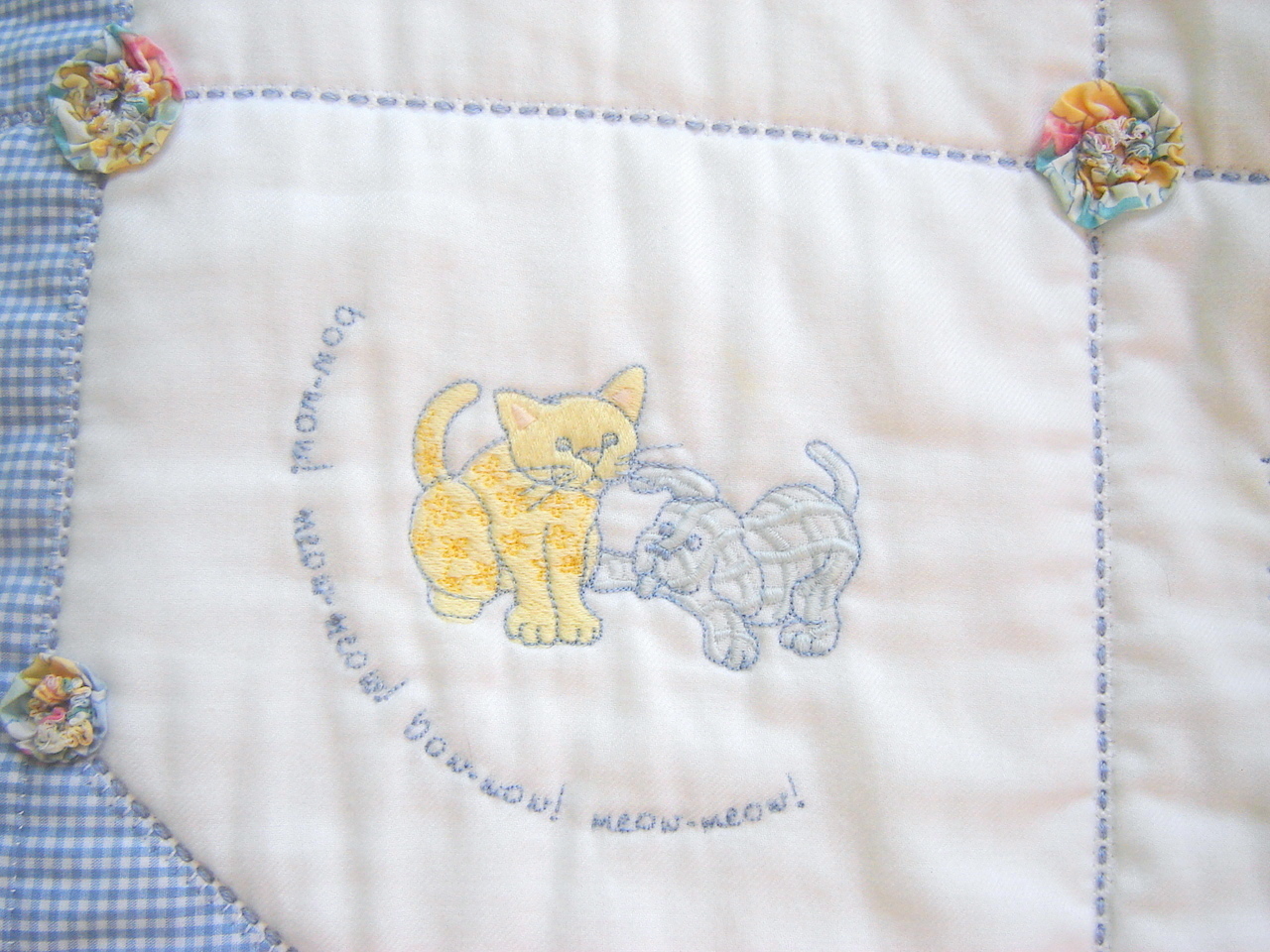
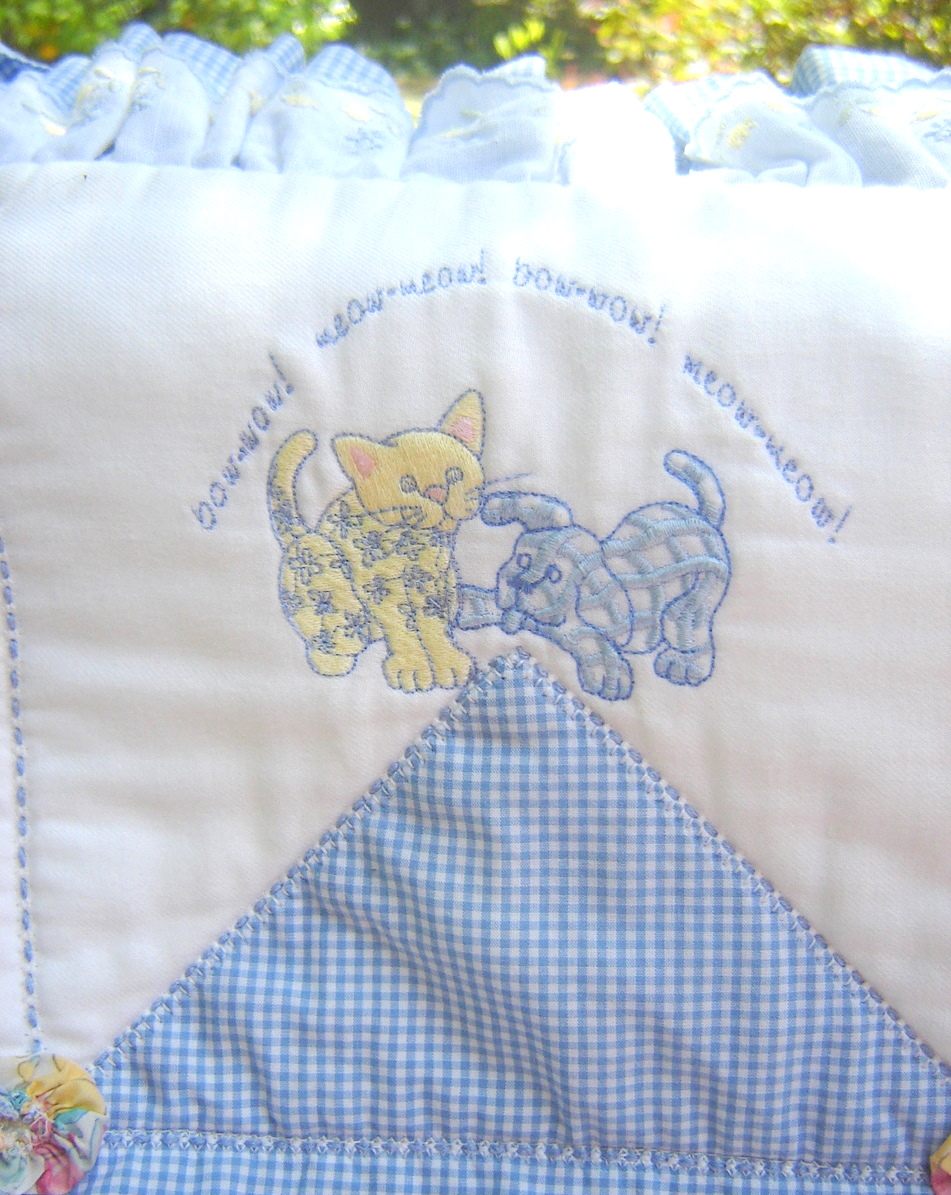
DOG/CAT EMBROIDERY:  All the text files were stitched, including the poem itself as well as the “bow-wow” and “meow” text.  The gingham dog and calico cat was a design from Dakota Collectibles.  Suzanne arranged the text in an arc or wave over the dueling pets.

In an effort to  reduce the stiffness of the  design, the white portion of the gingham dog design was omitted, allowing the white flannel to do the job.  The design was often mirrored for variety.  The shades of blue and yellow 50 wt. DMC machine embroidery thread were varied for the same reason, to create  interest and variety.   Continue reading

Gingham Dog Quilt Part I

This is one of my all-time favorite projects.  My dear friend, Suzanne Sawko, and I collaborated on the design, she digitized the straight line text and I sewed it.

It was a major project and telling you about it will take more than one post.  I doubt many of you would have the patience or endurance to plow through all the details at one sitting.  However, those of you who seek new techniques might find some tidbit of interest in the non-conventional creation of this quilt.  So this is part one.

The quilt celebrates the amazing capabilities of today’s computerized home embroidery machines. Uncommon sewing and quilting techniques make the project interesting and relatively easy. With the whimsy of a classic children’s poem, the beauty of fine heirloom fabrics and the charm of embroidered gingham dogs and calico cats, this quilt has delighted each of my grandchildren.  It hangs now in our upstairs nursery, next to the crib.

crib with quilt rack

What makes this quilt interesting?  Well, the basic construction, for one.  I will never forget my original disdain for quilting, especially after hearing a non-quilter comment that to her it made little sense to cut perfectly good fabric up into little pieces and then sew it back together again.  At that time, I naively concurred.

But there is none of that cutting up and resewing here.  This quilt is very non-traditional in every respect but the design.

QUILT TOP CONSTRUCTION:  The foundation is a 50″ square of Swiss flannel,  a luscious but shifty fabric which creates its own challenges.  Pulled threads created a centered grid of 7″ squares.  After the threads were pulled, the entire piece was starched and pressed.

Continue reading

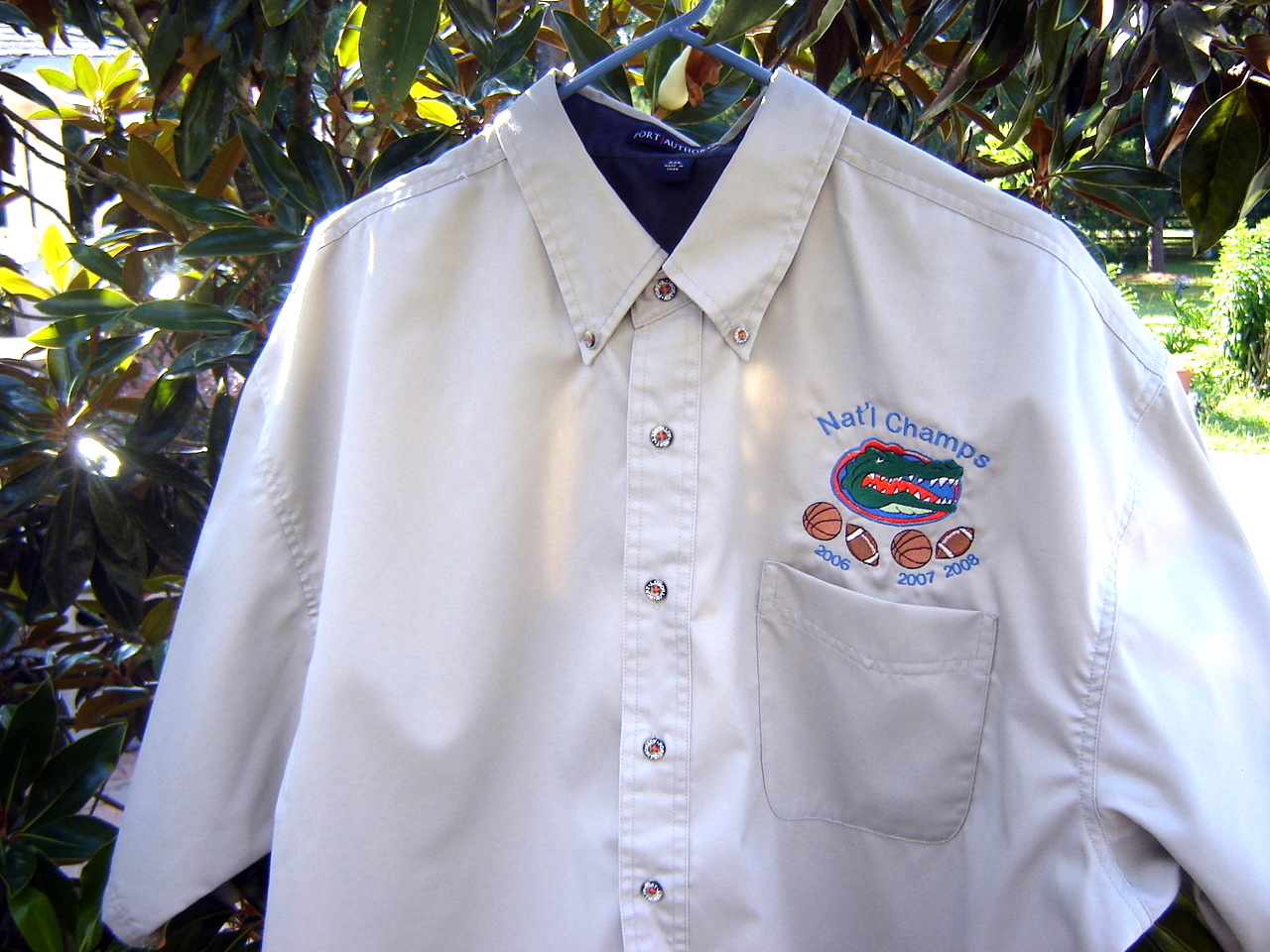
Roger’s Gator Shirt

You’ve heard it before—our family loves the Florida Gators. Bbut that doesn’t make us unique in this state, or any state for that matter.  The Gator Nation is huge.  Every time the subject of college sports comes up, more Gators make themselves known.

This was the case when I went to out-patient therapy for my first knee replacement  two years ago.  My wonderful therapist, Roger, not only loves the Gators but was himself a lineman on the team during his years in Gainesville.  He attends every home game, as good a fan as he is therapist.

He’s a big, tall guy, size 3XL, a size unavailable in much of the Gator Gear line.  So I was pleased to be able to embroider a shirt for him, in his size.  Continue reading

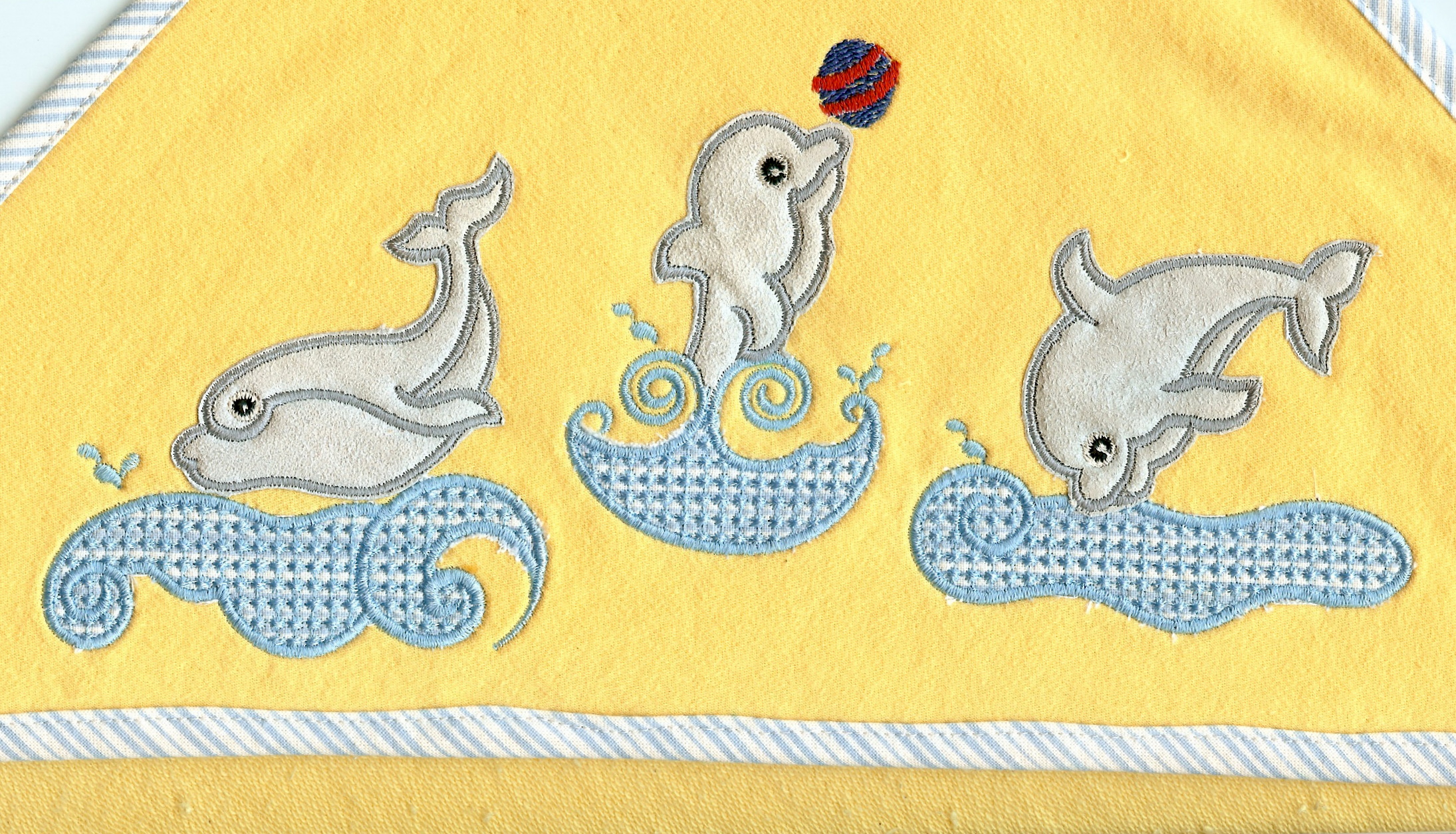
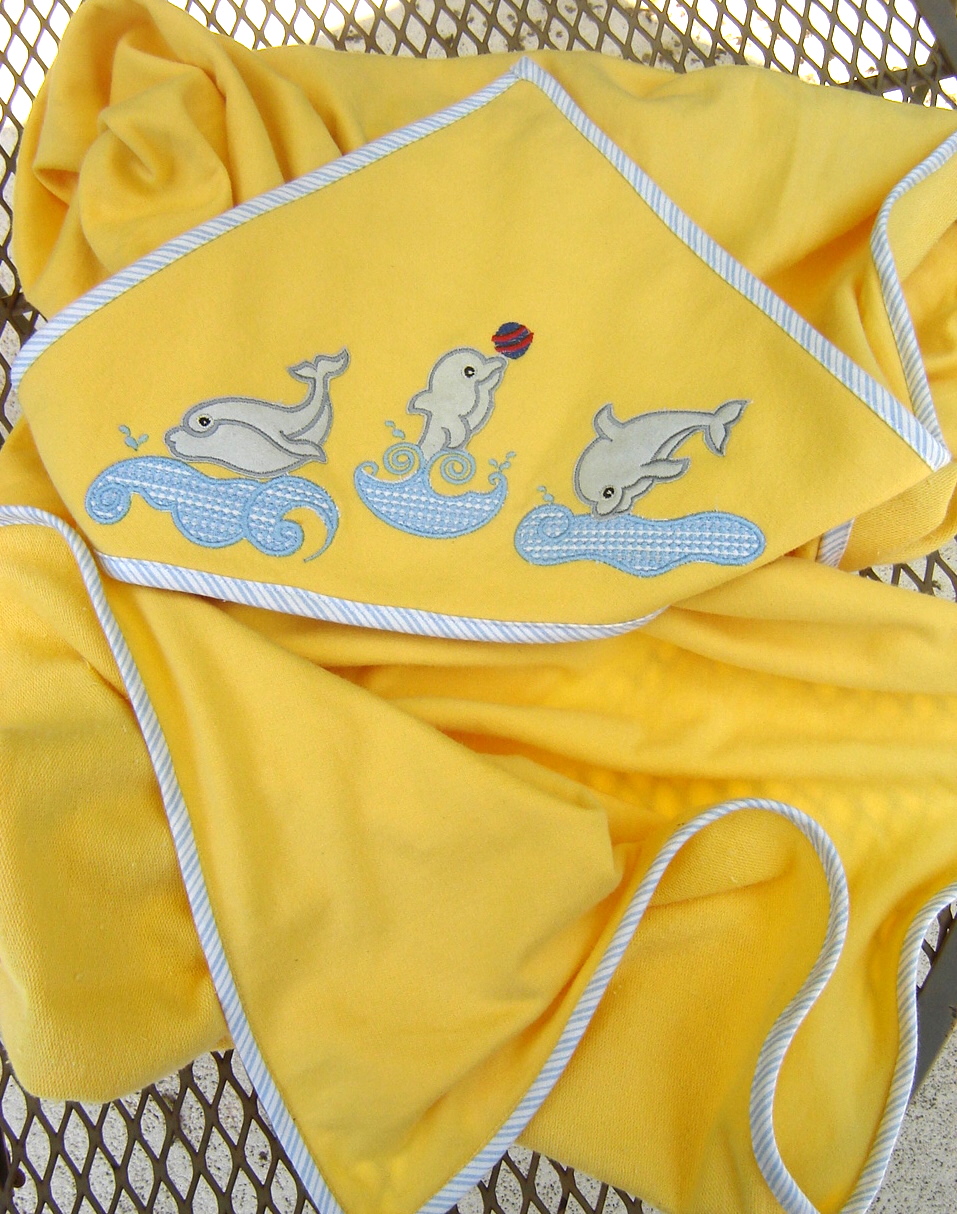
Robert’s Yellow Towel

Well, I finally finished Robert’s long since requested yellow towel and I must say I am pleased with the result.  I have only a scan of the hood and will post a better picture tomorrow.  But I’ve got some bug–or the bug has me–and I didn’t get an outdoor shot of the project today as planned.

First, I have to thank Elisabeth for her recommendation of fabric.com.  I found what they called yellow “French terry,”  but there are no loops which indicate terry to me.  But it is nice, thick, and stretchy–good for wrapping around a little guy.

a new day, a new picture

I cut the 60″ fabric into a 45″ square and then cut a 20″ square for the hood.  Fusible knit stabilizer was ironed on to the back of the piece in the embriodery area.  The square was folded in half diagonally and the embroidery centered.  After the embroidery, the square was cut down to measure 20″ on the diagonal. Then the folded edge was bound. Continue reading
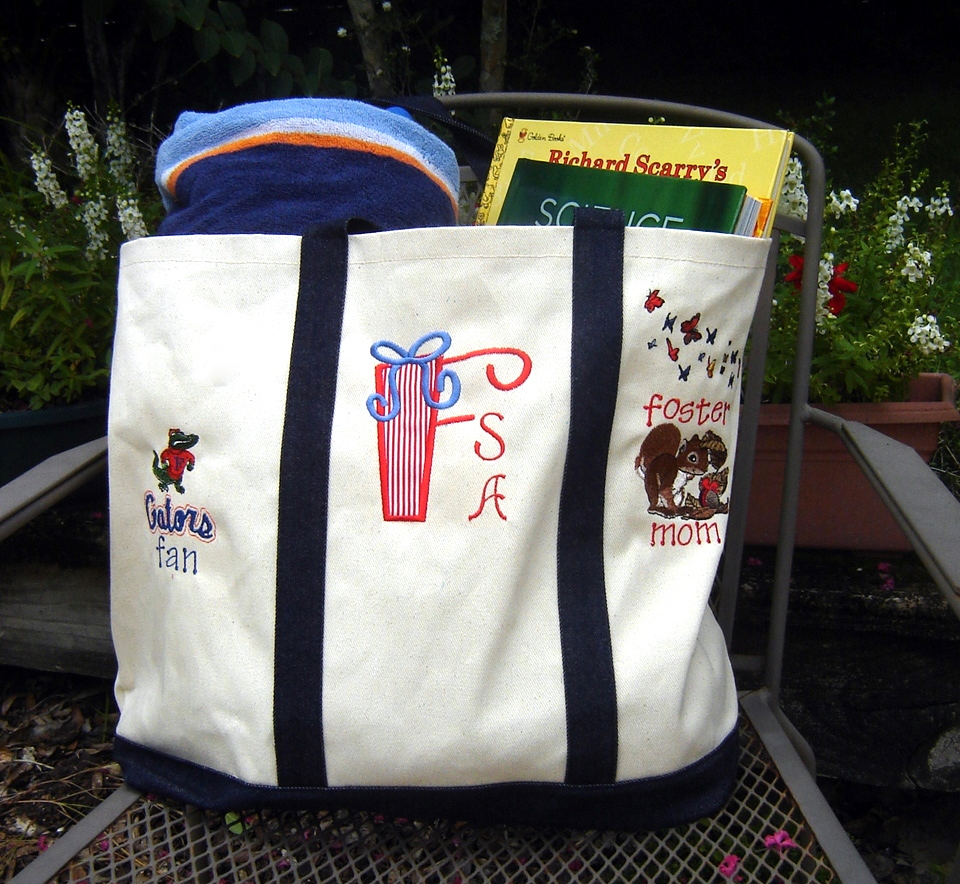
Busy Mom Tote Bag

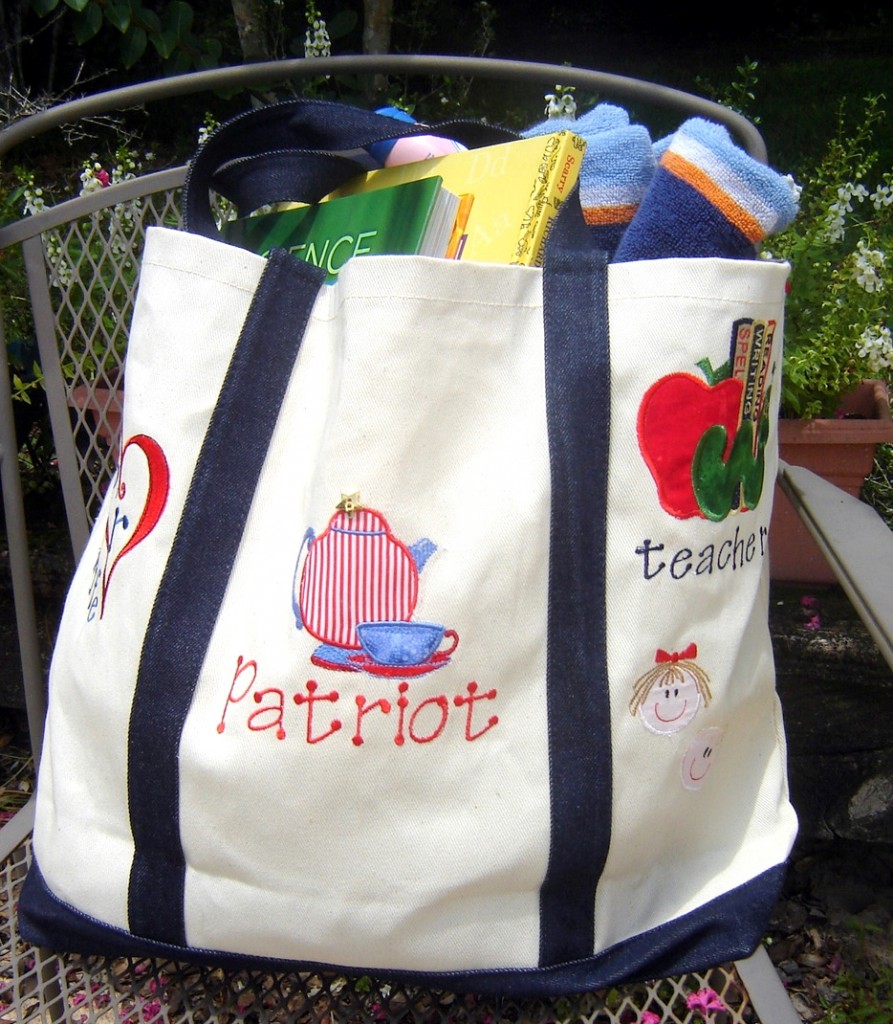
This bag is more a product of perseverance than creativity.  As I sat down at my embroidery machine for the first time in almost 3 weeks, I forgot to rotate the  first design to be directionally correct on the upside down tote.  It took more than 3 hours to pick that out!

If I had been able to drive, I would have pitched the bag in the trash and bought a new one.  But I wasn’t yet up to driving and Bob was out of  town on business,  so I just sat with the tweezers and picked and picked.  That canvas does not like to give up stitches!

A late birthday gift for my dearly loved daughter-in-law, in response to her quiet request,  it is but a small token of my affection and respect for her, even with all the aggravation.

Made of heavy canvas, it was necessary to open one side seam and turn the bag inside out in order to stitch a panel to hooped heavy cutaway stabilizer.  The canvas is so heavy that the stabilizer was not needed for design stabilization, but rather to serve as a sturdy base to support the bag as it was jostled around during the embroidery process.

Continue reading

Independence Day Celebration

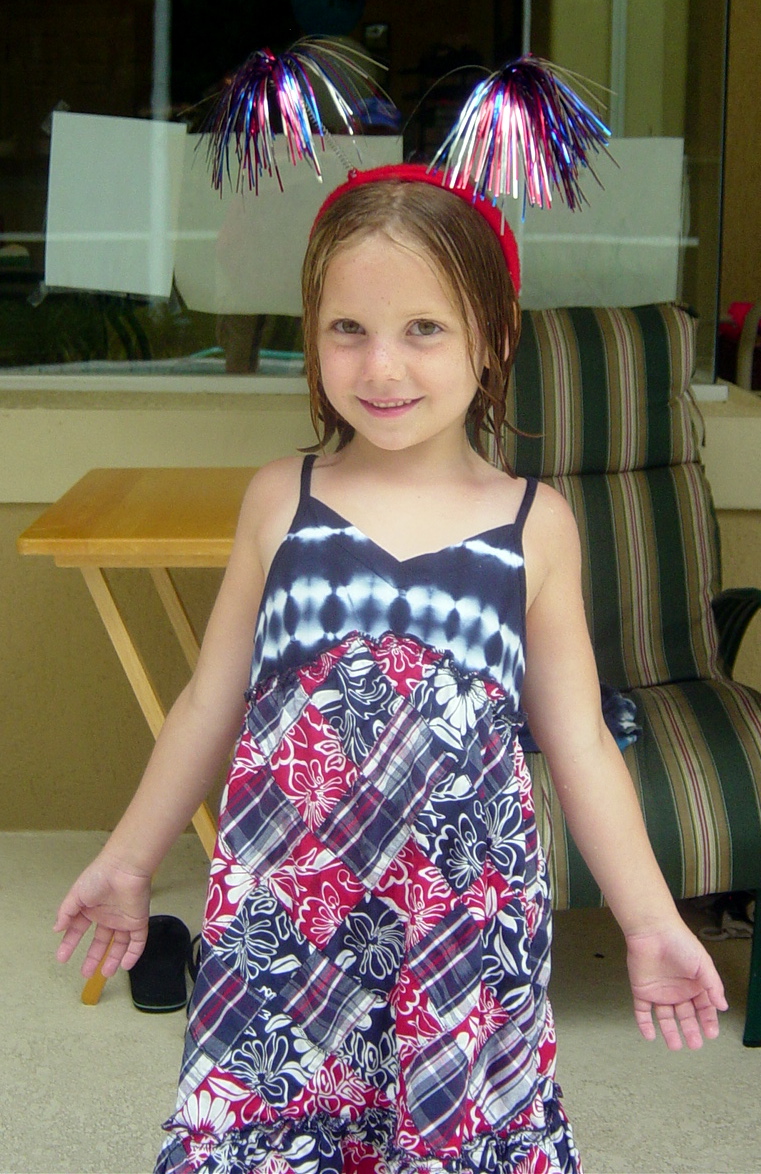
Laurel, still wet from swimming, is now dressed for patriotic partying.

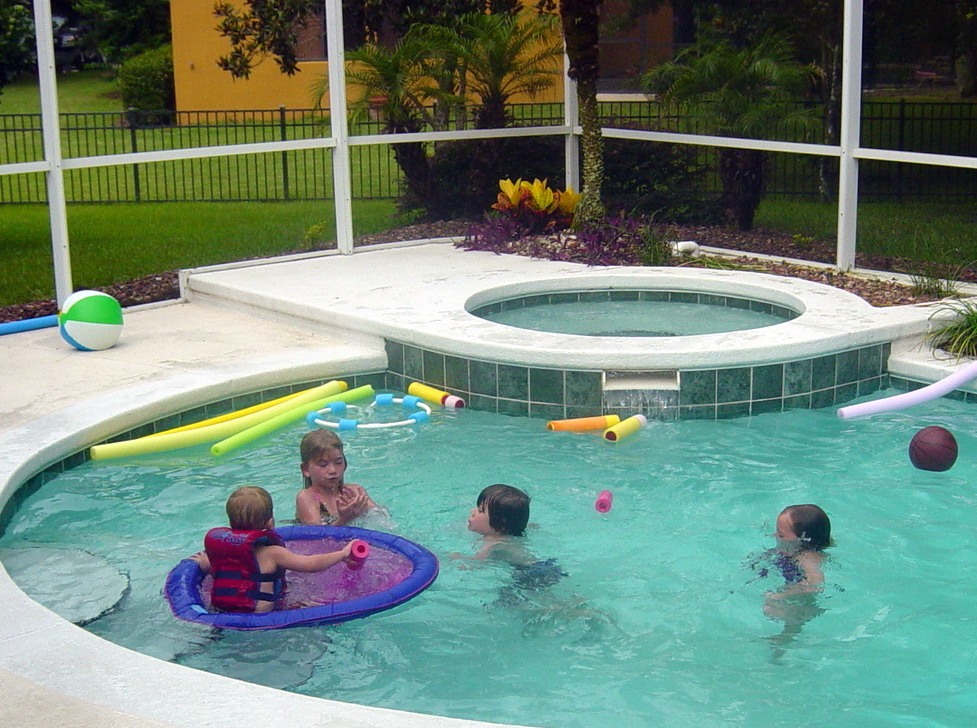
swimming, America's favorite summer sport

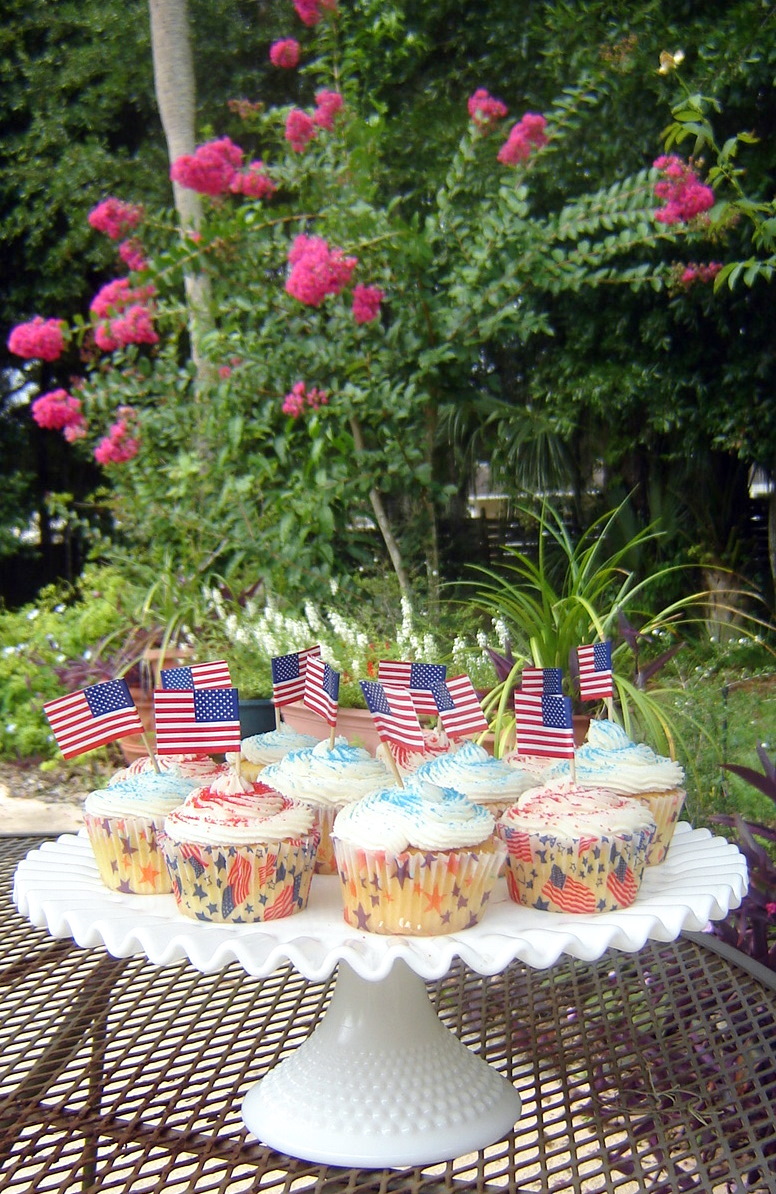
What a fabulous Independence Day celebration we had at our son’s home!  The festivities included red, white and blue games and activities for the children, six cousins ages 4-9.  Motivated by patriotic fervor, the disturbing national statistic that 25% of the US population does not know from which country we declared independence,  and her  homeschool mama/teacher drive to educate her children, the games were really civics lessons in disguise.  The children  loved it.  I am sharing the details with you in hopes that Shelly’s ideas will be incorporated into future Independence Day celebrations and that appalling statistic will be significantly reduced.

Given the possibility of rain, swimming was the first activity on the agenda.  Of course, this was the children’s first choice as well. 

 While the adults visited and applauded the children’s strokes, dives, somersaults and belly flops, the little ones played with reckless abandon.  Four year-old Robert started the day with a belly ache and was a reluctant participant all day.  Still, while cuddled up on my lap, sucking his thumb, he enjoyed watching the swimmers. But then the lessons/games began. Continue reading
Happy July 4th!

I hope you are all celebrating the birth of our great nation with family and friends.  We’re enjoying the day with our son and his family, along with a host of extended family, including four of Robert and Laurel’s cousins, aunts, uncles and maternal grandparents.

Shelly has organized a patriotic scavenger hunt.  Additional activities include a George Washingt0n ID game.  The children will be shown a picture of George and then search through a big plastic bin filled with buttons and coins, including many quarters.  They will be challenged to find as many as possible and then each child will be allowed to keep 4.

I’m bringing a great Asian salad, aka “Oddball Salad”, a recipe from my son-in-law’s mother, Carol.  Many years ago, she brought this salad to a family gathering and was preparing a container of leftovers for her father.  When she asked what he would like to take home he said, ” Anything but that oddball salad.”  He was the only one who didn’t like it so it is served regularly for family get-togethers. And it has been officially renamed Oddball Salad.  The recipe is below. Continue reading
Under the Sea

undertheseaKennedyBrite


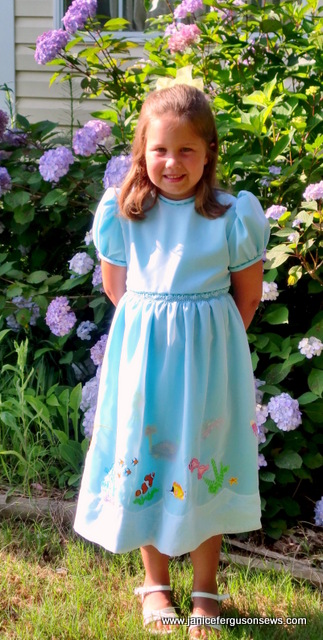
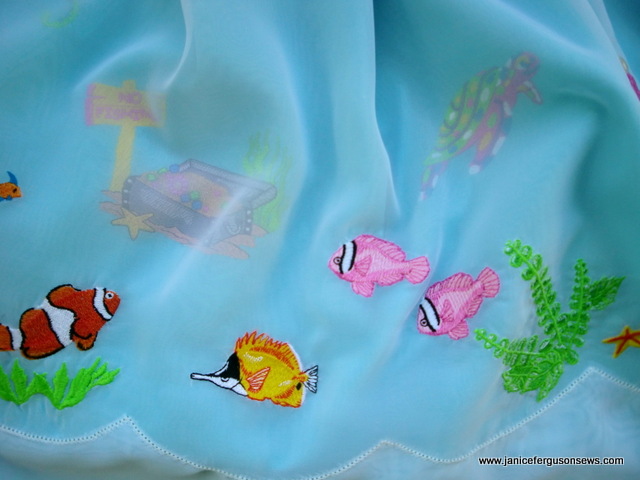
This dress is just breathtaking.  Judy Day has been working on it for more than six months–well, on and off for six months, as she dealt with other must-do’s that popped up.  This is her granddaughter’s 6th birthday dress and Kennedy is just as lovely as the dress!

I’ll let Judy tell you about it.~~~~~~~~~~~~~~~~

“I made this dress for Kennedy’s birthday.  She has been crazy about fish from day one.  When I saw a picture of a similar dress on Martha Pullen’s weekly e-letter last year, after her event in Arlington, I just knew Kennedy would love it.

The planning took more time than the actual embroidery.  I tried several different fabrics for the dress overlay.  Of course, Swiss batiste would have been perfect if it did not require a lot of starch and pressing.  So I decided on a sheer poly fabric for the easy care.  I ordered several different ones from www.fabric.com

I knew the underdress would be Imperial broadcloth.  I searched my stash and did not find a blue that would work.  When an overlay is put over a color fabric, the color must be a bright, clear color or it looks muddy.  I ordered 4 yds.of 4 different bue fabrics from Baltazor Fabric Boutique www.baltazor.com ….one can never have too many blues in their stash!


under the sea overlay


Baltazor’s has wonderful customer service.  They only had 3 of the blues, so they picked another and then included a 5th at no charge!  It was one of the fabrics they chose that was perfect.  The color was clear and bright even with the overlay.  The overlay gives the dress depth so that some of  the fish look as if they are swimming in the distance. Continue reading

Biscuit Lace Bonnet

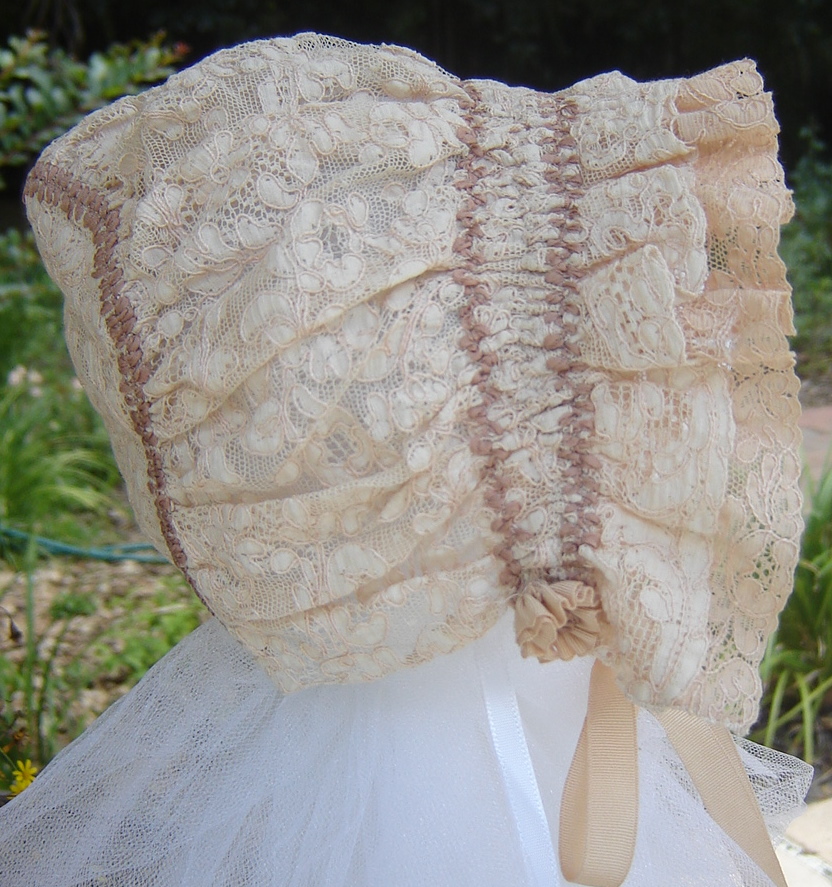
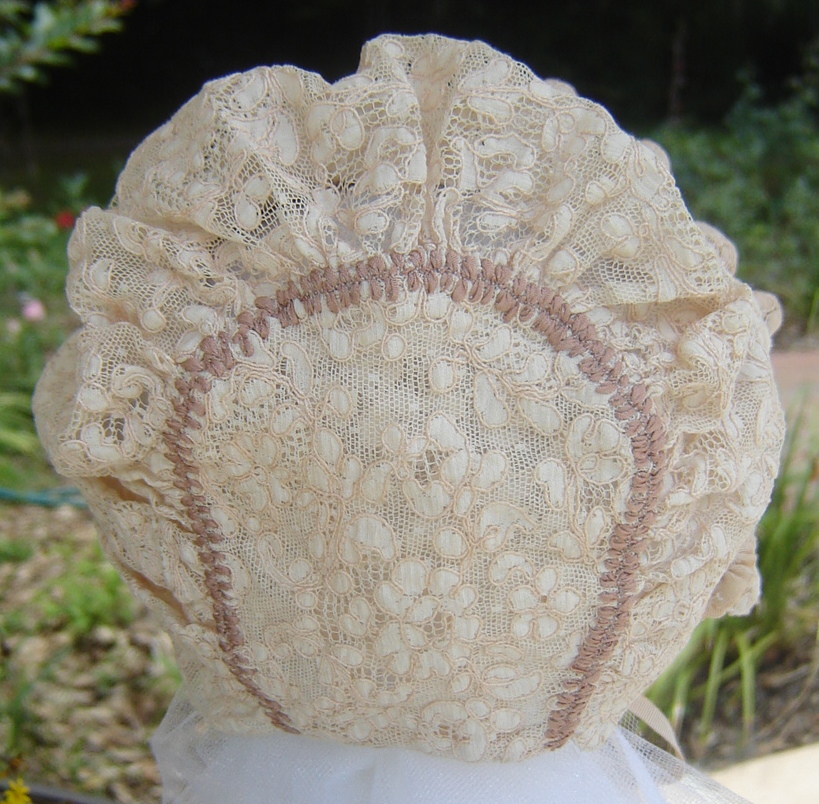
This brownish pink “biscuit” colored lace has always appealed to me.  I know nothing about the history of biscuit lace, but I want to believe that it was popular in the Victorian era, a time of lavish display, a time when “too much is seldom enough.”  NOTE:  This was labelled as the decorating style of a woman whose home was featured in one of my favorite  books,  Make Room for Quilts by Nancy J. Martin.

With as little as 20″ of lace 5″ wide, you can make a similar newborn size bonnet using the technique of ruching.   Given that a newborn measures approximately 12″ from ear lobe to ear lobe,  any length beyond that can be ruched (gathered) for some fullness and transformed to a bonnet.

For the horseshoe crown, another 5″ of lace is needed.  It is customarily lined, enclosing the gathers of the body of the bonnet between the lining and the back.  But if there is a shortage of lace, the lining could be made of cotton netting.

Two pieces if lace have been used to create this luscious bonnet.  The bonnet body is a very intricate 5″ wide lace galoon,   27″ long.  A second lace, a 2″ edging, was machine stitched to the wrong side of the galoon, leaving 1″ of  the edging exposed. After the two straight pieces of lace were joined together, three rows of gathering threads were stitched, a scant 1/2″ apart, beginning at the stitching that joined the two laces together.  The gathering threads were then drawn up to 12″ and tied off. Continue reading